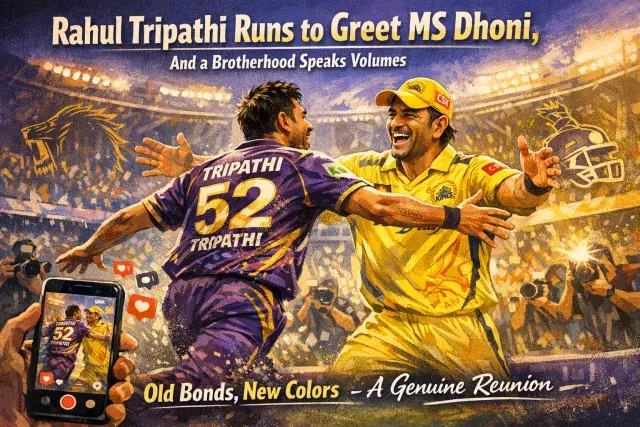
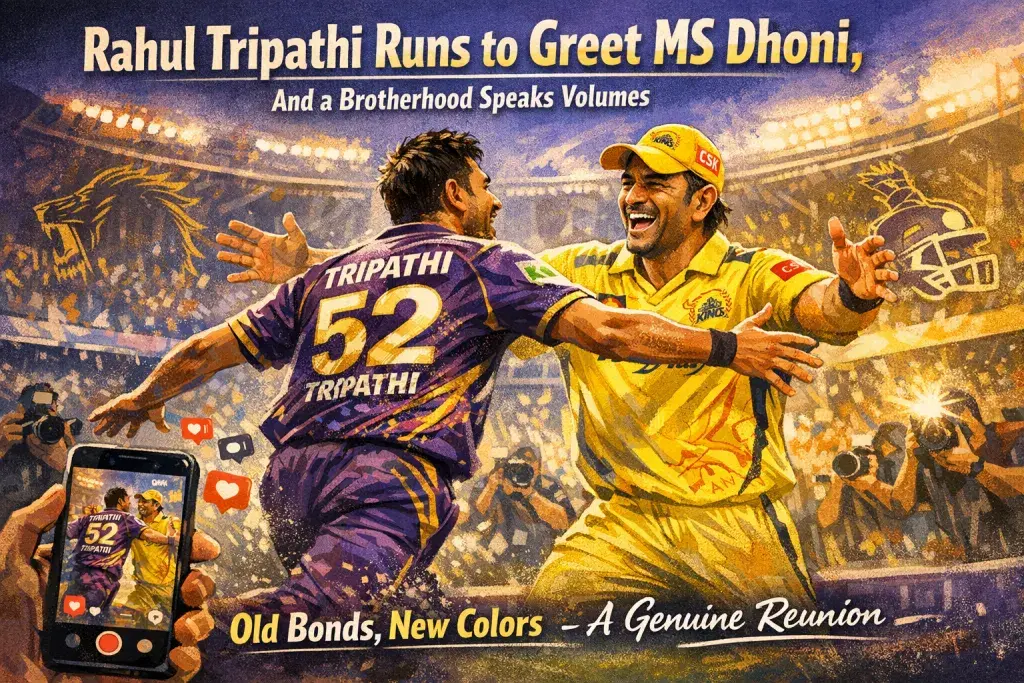
Before the first ball was bowled between Chennai Super Kings and Kolkata Knight Riders on April 13, 2026, the moment that captured the most attention happened off the field entirely. Rahul Tripathi, now wearing KKR colours after being acquired in the recent auction, sprinted toward his former captain MS Dhoni the moment he spotted him — a reunion so unscripted and warm that CSK's own official handle posted it with the caption, "Rahul Bhai, who got you smiling like that?" The clip spread rapidly across social media, accumulating widespread engagement within hours of being published.
What the Video Actually Showed
There was nothing performative about the exchange. Tripathi, who spent his most recent IPL season under Dhoni's captaincy at Chennai, closed the distance between them with visible enthusiasm — the kind of unrehearsed energy that does not survive in a press conference room or a choreographed photo opportunity. He had a conversation with Dhoni on the ground, the kind shared between two people who know each other well enough to not need a reason to talk.
CSK's decision to post the video under that particular caption was itself an editorial choice. It acknowledged the affection without sentimentalizing it, and in doing so, invited its fanbase into a moment they clearly recognized as genuine. The response from supporters was immediate and enthusiastic, precisely because nothing about the interaction appeared manufactured.
The Relationship Behind the Reunion
Tripathi was released by CSK following the IPL 2025 season, a routine outcome of the roster restructuring that precedes every auction cycle. He was subsequently acquired by Kolkata Knight Riders. That change in affiliation did not, evidently, alter the personal regard between him and Dhoni — a dynamic that is worth understanding in its proper cultural context.
MS Dhoni has, over more than a decade of IPL captaincy, cultivated a reputation not only as a tactically astute leader but as a figure who commands deep personal loyalty from those who have worked under him. This is not incidental. Dhoni's leadership style, defined by composure under pressure and a consistent prioritization of the collective over the individual, tends to leave a lasting impression on those who experience it directly. Tripathi's reaction on that ground in Chennai was a visible expression of that impression.
For Tripathi, there was an additional layer of significance. Chepauk — CSK's home venue — was effectively his professional home during his time with the franchise. Returning to that venue, now representing a rival franchise, carries a particular emotional weight. His run toward Dhoni suggested that the affection he holds for the place and the people in it has not diminished because of a change in contract.
Why Moments Like This Resonate Beyond the Boundary
The viral reach of this reunion reflects something broader about how audiences engage with professional sport and public figures. In an environment where most interactions between well-known personalities are mediated, scripted, or staged for maximum visibility, an unguarded human moment — captured incidentally and shared without heavy editorial framing — carries disproportionate emotional weight.
What people responded to was not the reunion itself, but what it implied: that the bonds formed inside high-pressure professional environments can survive the contractual structures that otherwise define those environments. For CSK's fanbase in particular, Tripathi's visible joy at seeing Dhoni served as a reminder that their admiration for their captain is not exclusive to them — it extends to every person who has had the privilege of working alongside him.
Whether Tripathi features prominently for KKR in this particular fixture remains to be seen. But the conversation he had with Dhoni before it began had already told a story that required no commentary.